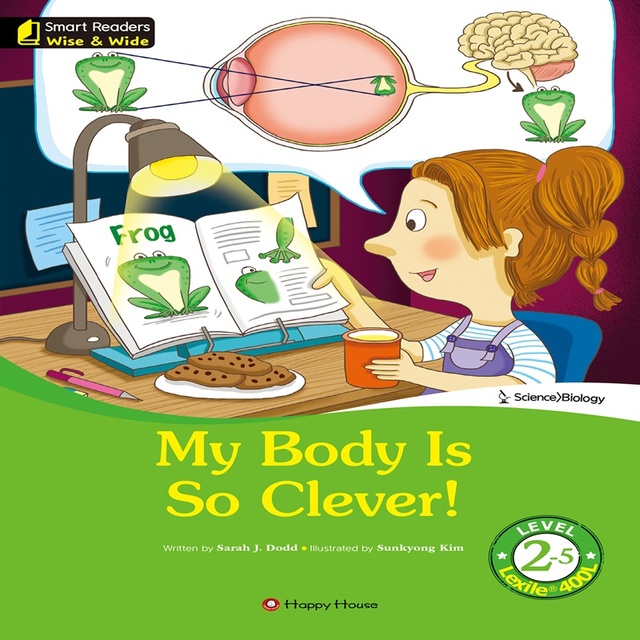
My Body Is So Clever!
Wise & Wide is a 6-level English reading program that consists of 60 books and each level is
systematically divided by Lexile Ⓡ measures. The Lexile Ⓡ Framework for Reading is the most popular reading measuring system in American formal education curriculums and many English programs.
Over 20 out of 50 states in the U.S. mark Lexile Ⓡ measures directly on students’ final report cards and over 300 well-known publishers adopt and use Lexile Ⓡ measures.
Experience many kinds of readings written by professional writers from the U.S. and England. They used interesting topics that were carefully chosen after analyzing elementary curriculums from around the world including Korea, the U.S., England, and Australia among many others.
Before Reading
What does the brain have to do with sensory organs?
When you suddenly enter a bright place after being in a dark place, you frown and cover your eyes before you know it. Who on earth asks you to do so? It is your brain, an organ cleverer than a super computer, making you do so in order to protect your eyes from the strong light. Isn’t it amazing that the brain makes your body react to the sight of strong light within one second? Our body accepts the five senses of sight, hearing, smell, taste and touch. When these senses are delivered to the brain, it gives instructions to each part of the body how to react to them.
In the book, we will find out the relationships between the sensory organs that accept the five senses – the eyes, ears, a nose, a tongue and skin – and the brain in detail.
Summary
We use our eyes to see. After going through complicated organs behind the pupils, our brain recognizes what we see. We have two pupils, but some animals have even more. Can you imagine that there are some fish that have four pupils? And there are also some fish that have no eyes.
We use our ears to hear. Our ears also have many parts and each part has its own role. Even earwax that we think is dirty has an important role.
We use our nose and tongue to smell and taste. The nose smells some food and that smell affects our sense of taste. Therefore, you can’t taste well when you catch a cold and have a stuffy nose.
We use our skin to touch. Cold, heat and pain can be felt by the skin, which regenerates itself every two weeks.
Your sensory organs get stimulated and your brain instructs your reactions accordingly. In the book, let’ s learn about the sensory organs and the brain of our clever body in detail!